Still Yours · the course
A structured way to use AI across your doctorate, in ways you can explain and defend
Seven self-paced modules that help you decide, task by task, where AI belongs in your doctorate, with practice on your own work in every one. Comes with the companion toolkit and 20% off the book, Still Yours.
Save my placeNothing to pay now. The course opens early in 2027.
Why this course
Why ‘be careful with AI’ isn’t enough
A few questions decide how your doctorate goes with AI in the mix. Does this use of AI build you as a researcher, or does it replace the work that development was going to come from? And can you explain what you did, and why, if someone asks? Most doctoral researchers have never been given a structure for answering these in the moment, in the middle of a half-finished literature search or a paragraph that won't come right, only a general sense that they should be careful about it.
That gap shows up at the point it's tested. A polished piece of work no longer proves, on its own, that you did the thinking behind it. What proves it is whether you can explain the judgement calls when someone asks, in a supervision meeting or a viva. That's a skill you build by practising it, task by task.
The course
What this is
The Doctoral AI Operating System is seven self-paced modules covering the five ways you'll work with AI across a doctorate: as a thinking partner, research assistant, writing collaborator, mediator of your professional relationships, and project manager. Each module pairs a worked example with practice and a developmental check, so you build the habit of good judgement.
The book gives you the thinking
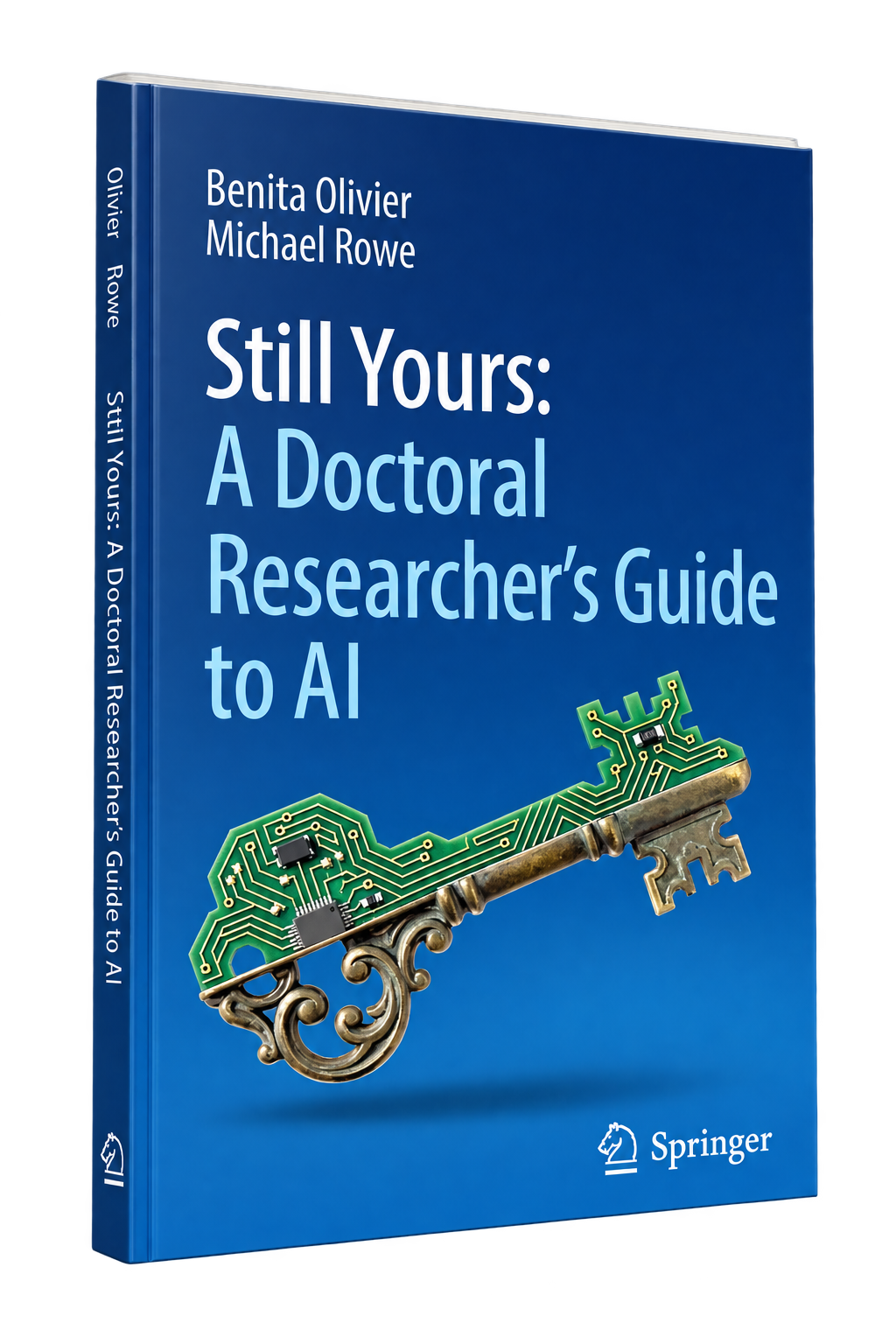
Still Yours is what you read and refer back to. It's yours to keep, so it becomes your set of notes long after the course ends.
The course gives you the doing
The course is hands-on. In every module, you practise on real tasks from your own doctorate, so the ideas in the book become habits you use.
Who it's for
Who is this for?
It's for doctoral researchers in the broadest sense: PhD, EdD, DBA, professional and practice-based doctorates, and doctorates by publication. If your degree asks you to make an original contribution through your own disciplined inquiry, this is for you. It works whether you're in your first year or close to submission.
Outcomes
What you'll be able to do
By the end of the last module, you'll have four things you can use straight away.
Decide in the moment
The habit of asking the questions above whenever you reach for AI, and answering them while the work is in front of you.
A workflow you can defend
One real task from your own research, written out step by step, showing where AI helps and where your own judgement does the work.
Your written terms
What you will and won't use AI for at your stage of the doctorate, in your own words, decided before a deadline decides for you.
A 200-word defence
Of one real decision about AI in your own work: the kind of explanation a supervisor or examiner might ask you for.
Curriculum
The seven modules
A foundations module, one module for each of the five ways you'll work with AI, and a capstone. Each draws on chapters of Still Yours, and you carry tasks from your own doctorate through all seven.
1
Foundations: what AI can and can't do in research
Where today's tools help and where they fall short, why the thesis was never the point, and the questions you'll use in every module after this one.
2
AI as thinking partner
Using AI to test and stretch your thinking rather than hand it over: the four-part prompt, learning what you only half-understand, getting your bearings in a new area, and preparing for panels and your viva.
3
AI as research assistant
Research design, finding literature, reading and synthesis, and data analysis. The risk looks different in each, so you learn where it sits and write a workflow you can defend for a task of your own.
4
AI as writing collaborator
Why writing is where the thinking happens, four ways to work with AI on a draft, one paragraph taken through three versions, and how to test each sentence and declare what you used.
5
AI as mediator of relationships
Supervision, milestones, peers and co-authors: using AI to prepare your thinking rather than a persona, reading hard feedback fairly, and keeping a context record so the tool stays useful.
6
AI as project manager and life organiser
Planning with AI, where the hours it saves you actually go, your doctorate within the rest of your life, and what to check before you connect AI to your calendar.
7
Capstone: what to protect and what to show
Which struggles are worth keeping, whether you'd catch the error, and pulling the course together into your written terms and your 200-word defence.
Format
How it works and what you get
Each module follows the same pattern. You watch short video lessons, apply them to your own task with a worksheet, and finish with a developmental check: three questions, one piece of practice you do without AI, and a moment to check in with yourself.
Seven modules
Short video lessons you can fit between other work
Knowledge checks
Short quizzes in every module that explain the reasoning behind each answer
Worksheets
To apply each module to your own task
A private community
Ask questions and share milestones. I reply within three working days.
The companion toolkit
Interactive tools to plan, record and defend your AI use
20% off Still Yours
A link for 20% off the book, in print or digital
Six months to complete the course
From the day you join, at your own pace
A certificate
When you complete the final module
About

About me
I'm Benita Olivier, Professor of Rehabilitation at Oxford Brookes University and Allied Health Professions Research Lead at Oxford Health NHS Foundation Trust, where I build research capacity and capability among health and care professionals. I've supervised more than 40 postgraduate students to completion over more than 18 years, and I absolutely love it! I founded Research Masterminds to support postgraduate researchers around the world.
The course is built on Still Yours, which I wrote with my co-author, Michael Rowe, Associate Professor at the University of Lincoln.
Price
£297
The full course and the companion toolkit, plus 20% off the book, Still Yours.
There's nothing to pay yet
Add your name to the waitlist, and I'll email you when the course opens.
I'll only email you about the course. Unsubscribe any time.
Questions
Frequently asked questions
Do I need to have read Still Yours first?
No. Each module opens with what it needs from the book, so you can start without it. If you'd like the full argument, the course gives you 20% off the book, in print or digital.
How does the 20% off the book work?
When you join, you'll get a link to buy Still Yours from Springer Nature with 20% off, in print or digital. It's an affiliate link, so I earn a commission if you buy the book through it. It doesn't cost you anything extra.
Is taking this course against my institution's AI policy?
No. The course teaches you how to decide where AI belongs in your doctorate and how to explain those decisions. It doesn't ask you to use AI in any way your institution doesn't allow. Institutional rules vary and keep changing, so wherever your institution's policy is stricter than what the course discusses, follow your institution's policy.
How much time does it take?
The videos are short, and most of your time goes into practice on work you're already doing for your doctorate. You set the pace within your six months.
Does joining the waitlist commit me to anything?
No. You'll hear from me when the course opens, and you decide then. Joining the waitlist doesn't sign you up to anything else.
How long do I have to complete the course?
Six months from the day you join. The companion toolkit is yours to keep after that, so you can come back to the tools whenever you need them.
What if I'm not sure it's right for me?
Ask me before you join. The whole course opens to you on the first day, so refunds will be impractical once you've joined. I'd much rather you were sure first, so join the waitlist and reply to any of my emails with your question. I'll answer it myself, and you can ask follow-up questions, any time.
Waitlist
Save your place
The course opens early in 2027. Join the waitlist, and you'll hear first when it does.
Save my placeStill Yours: A Doctoral Researcher's Guide to AI, Benita Olivier and Michael Rowe, Springer Nature, 2026.
Research Masterminds
© 2026 Research Masterminds LLC · Website Terms